Biosafety and
Contamination Control
Protecting personnel, product, and the environment
Diverse applications in the life science, clinical, pharmaceutical, and industrial laboratory fields must protect personnel, product, and the environment from exposure to biohazards and cross-contamination. Due to the critical nature of such laboratory work, technology is designed and manufactured to meet specific needs of the workplace and to operate within a performance envelope which guarantees the widest margin of safety and product protection for the most demanding laboratory conditions.
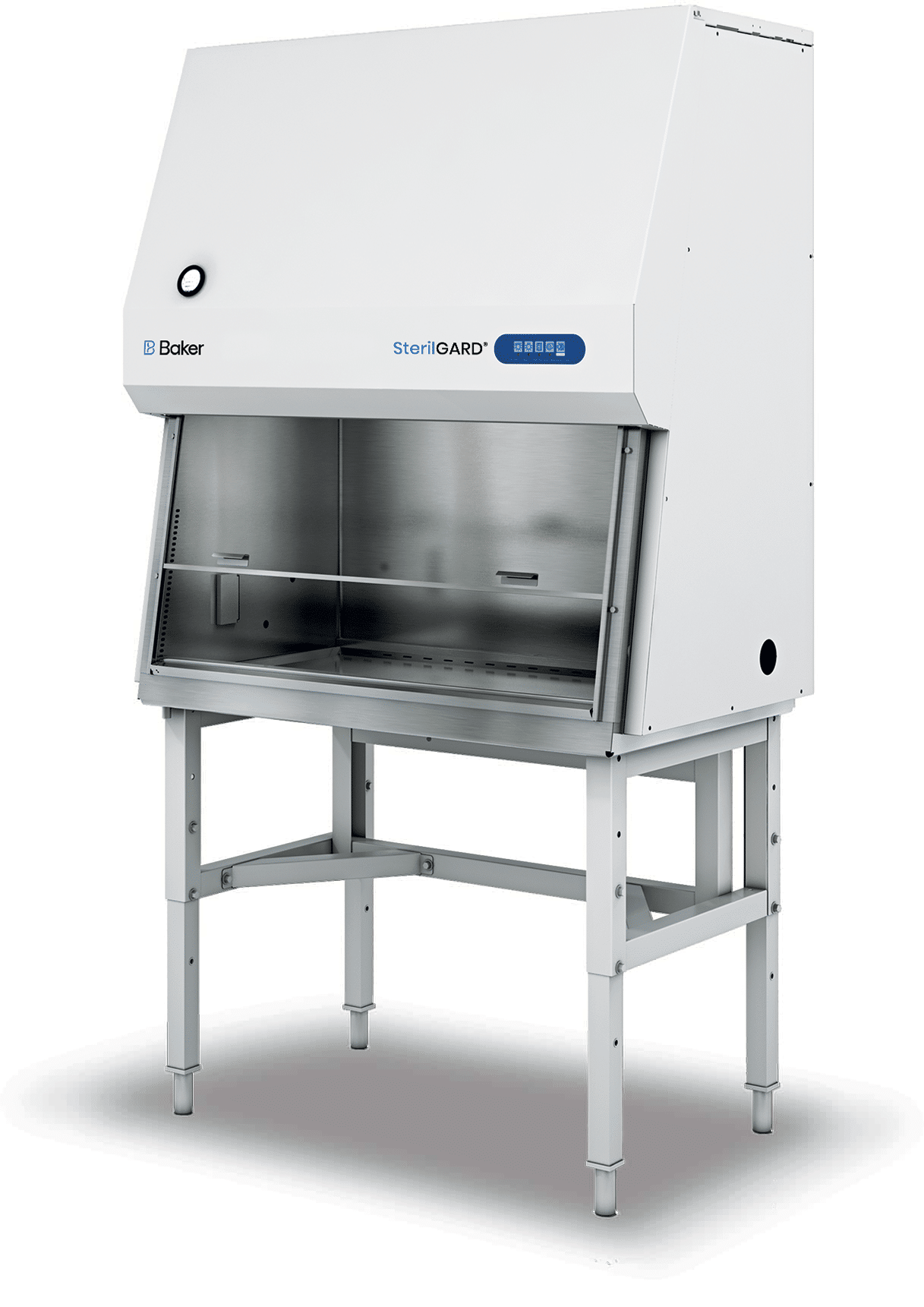
Since Baker developed the first clean air workstation in 1951, biosafety cabinets have played a critical role in ensuring the safety of lab personnel and the integrity of their work. In varying degrees, a laminar flow biological safety cabinet is designed to provide three basic types of protection.
The first is protecting personnel from harmful agents inside the cabinet. The second is shielding the work, experiment, or process from contamination. The last is environmental protection or safeguarding the lab from contaminants within the cabinet.
Classification is an important consideration in the selection of any biological safety cabinet. Over the years, the scientific community has adopted commonly accepted classification criteria to differentiate containment capabilities and performance attributes. Biological safety cabinets are divided into three classifications. Baker designs and manufactures all of these types of biosafety containment cabinets.
Cabinets are also required to pass field certification by an independent organization. NSF has established standards for field tests that define the methods and acceptance criteria appropriately applied for determining qualification for field certification of all class II biological safety cabinets. These field certification procedures are intended to confirm that an installed cabinet evaluated under the current version of the Standard has met all design criteria contained in NSF/ANSI 49.